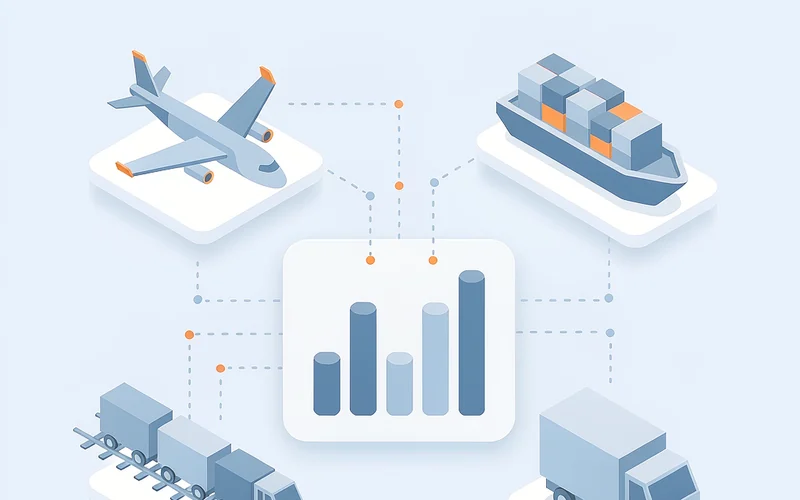
Freight becomes manageable once you split it into four buckets, ex-works price, origin and inland charges, main carriage, and destination charges, and once you know which of those your agent quotes as a disclosed line. Comparing a quote without that split is the most common reason a landed cost looks cheaper than it is.
Separate the four cost buckets
Start with the ex-works unit cost, which is the factory price of the goods alone. Add origin-side items such as inland transport, export handling, and any consolidation or warehousing before the vessel or flight. Then add the main carriage, and finally the destination-side items that apply on arrival. Duties, taxes, and clearance are commonly part of the destination bucket, but the exact treatment depends on the incoterm and the destination, so keep them as named lines in a written quotation rather than assuming a number. Our shipping and cargo consolidation service handles the origin-side piece.
FOB versus a delivered, DDP-style quote
Under FOB, the supplier's responsibility typically ends once the goods are on board, and you or your agent carry the carriage and destination costs from there. A delivered, DDP-style figure bundles more of those into one number, which is convenient but hides the split. The practical fix is to ask every supplier to quote on the same incoterm and to rebuild both into a single worksheet. We walk through that in FOB vs DDP landed cost.
Consolidation and warehousing
If you are buying from several factories, consolidation is where cost is often won or lost. Free warehousing applies for the first 60 days, after which storage is billed by CBM/day, which gives you a window to bring multiple orders together before one shipment. Low-value SKU handling is $25 on the rate card. These are disclosed lines, not margins added to the unit price.
How the agent fee interacts with freight
This is the detail many importers miss. Plan B is 5% of FOB goods value with a minimum $100 per order, so the percentage is calculated on the goods value at the FOB point, not on freight, duties, or the final landed total. Plan A is a fixed project fee from $290 per project and does not move with the shipment size at all. Either way the service fee is always disclosed and listed separately from the ex-works unit cost, with no hidden commission, no factory kickbacks, and no margin buried in the unit price; add-ons appear on a published rate card. See the China sourcing agent fees guide and the commission explained article.
| Bucket | Typical contents | How it is quoted |
|---|---|---|
| Ex-works goods | Factory unit price | Separate ex-works unit cost line |
| Origin side | Inland transport, export handling, consolidation | Disclosed rate-card lines |
| Main carriage | Ocean or air freight to destination | Per written quotation |
| Destination side | Clearance and delivery-side charges | Named lines in the quotation |
| Agent service fee | Plan A or Plan B | From $290 per project, or 5% of FOB goods value (minimum $100 per order) |
| Storage | Consolidation window | Free for the first 60 days, then CBM/day |
All figures here are indicative reference prices taken from the published rate card; the pricing page and a written quotation confirm the final numbers.
All figures quoted are indicative 'from' reference prices on our published rate card; final numbers are confirmed in a written quotation.
Next step
Send us your incoterm and destination and request a written quotation on the pricing page, or contact us to build the worksheet for your lane.
Want to source something similar?
Send a short brief and we will come back with a plan and a transparent quote.
Get a Free Quote